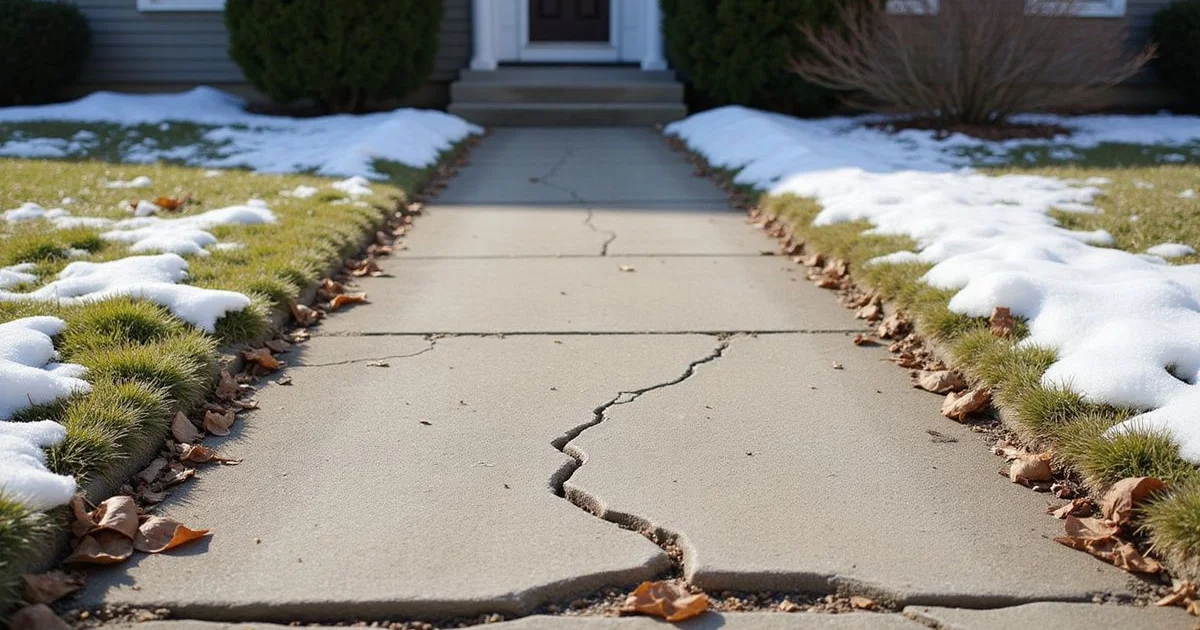
Why Connecticut Ground Moves Under Concrete
The Connecticut frost line sits at roughly 42 inches. That single number explains most of what goes wrong with flatwork in this state.
Building codes require footings to reach below the frost line, which is why your house foundation is sitting on stable ground four feet down and generally stays where it was poured. Driveways, patios, walkways, garage slabs, and front steps are not built that way. They sit on a compacted base a few inches down, right in the middle of the zone that freezes and thaws every single winter.
So the house holds still and the flatwork moves. That’s not a construction defect. It’s the design.

Understanding this is what separates a real fix from a cosmetic one. If you resurface a settled driveway without touching what’s underneath, you have repainted a problem that lives four inches below the paint.
The local specific
Every state with a winter has freeze-thaw. What makes Connecticut particular is the combination: a deep frost line, a long shoulder season of repeated melt-refreeze days, and heavy deicing salt use on top of both.
The Winter Washout Cycle
Here is the loop that turns a fine driveway into a dropped one, usually over three to five winters:
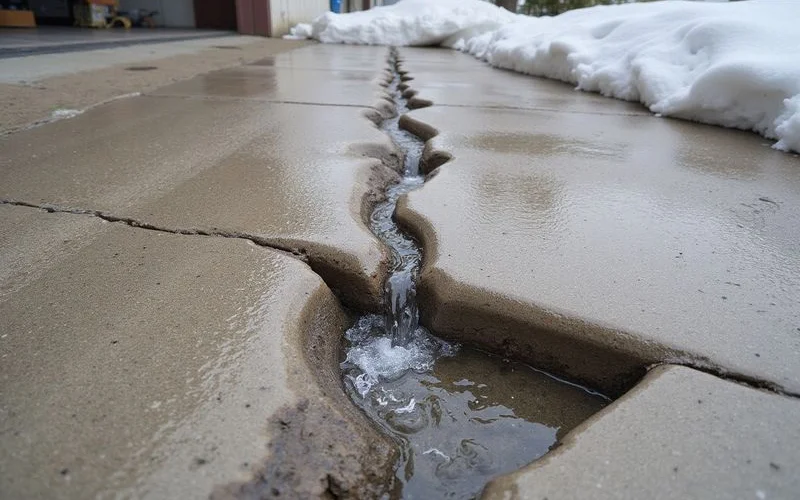
Water gets in. Through an open control joint, a hairline crack, or the gap between slab and foundation. Roof runoff and downspout discharge concentrate it at specific points, which is why settlement is almost never uniform.
It freezes and expands. Water gains about nine percent in volume when it freezes. Under a slab that has nowhere to go, that expansion pushes. Sometimes it lifts the concrete, sometimes it just displaces the compacted base sideways.
It thaws and drains. The meltwater leaves, and it carries fine material out with it. The base that was carefully compacted at pour time is now looser and smaller than it was.
The gap opens. What’s left is a void. The slab, unsupported over that patch, drops into it under its own weight and whatever drives across it.
Then next winter does it again, into a cavity that’s now bigger and easier for water to reach.
| Winter | What’s happening underneath | What you see on top |
|---|---|---|
| First | Water finds a joint, base material starts moving | Hairline separation at a joint, nothing obvious |
| Second to third | A measurable void forms under one section | A step you notice when shovelling, water sitting in a new spot |
| Fourth and beyond | Void widens, adjacent sections start to follow | A visible drop, a bumper-catching lip, water running toward the house |
Why the Fix Has to Address the Void
This is the argument against every surface-only repair. Grinding down a trip edge removes the symptom and leaves the cavity. Patching a joint slows water down for a season. Neither adds support back under the concrete, which is the only thing that was ever missing.
Polyurethane injection works precisely because it targets the cavity first. The foam expands into the void, fills it completely as structural material, and only then begins raising the slab. Because it’s closed-cell, it doesn’t take on water, so the next thaw can’t wash it out the way it washed out the original base. The step-by-step process covers exactly how that sequence runs.
Restoring pitch matters just as much as restoring height. A slab that settled toward the house is now delivering meltwater to your foundation every thaw. Bringing it back to grade sends that water where it was originally meant to go, which cuts the water supply feeding the whole cycle.
If your driveway is the slab that’s moved, driveway leveling covers what that specific job involves and what it costs.