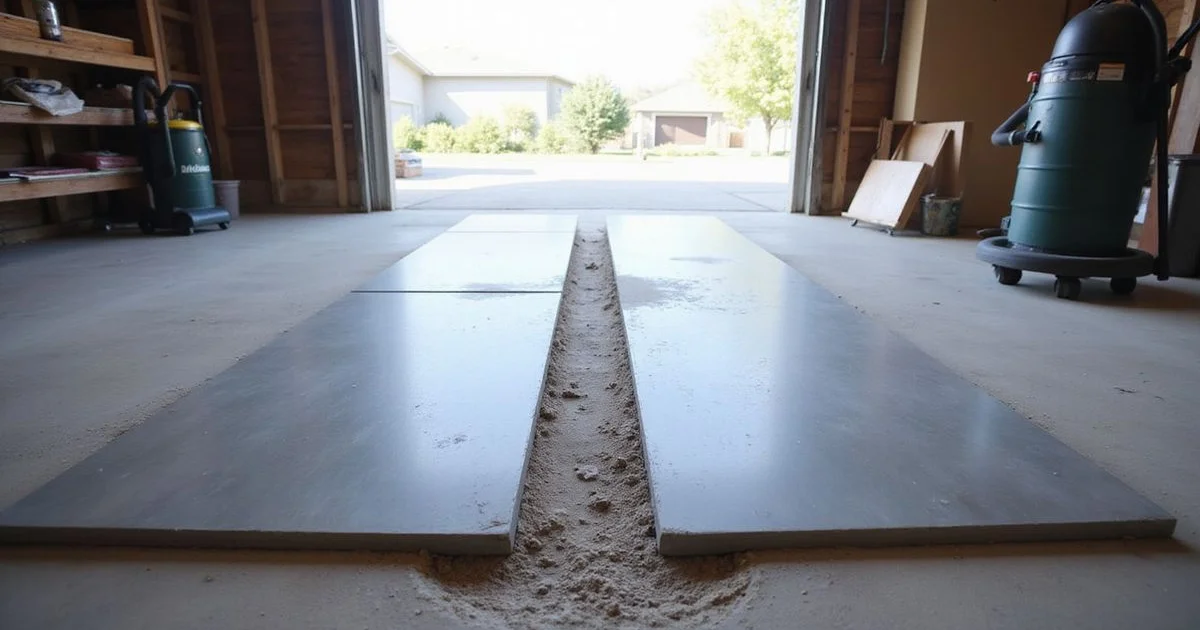
Two Slabs, Two Different Fates
A garage floor is not one continuous piece of concrete. It’s cast with control joints: deliberate cut lines that give inevitable shrinkage cracking somewhere planned instead of somewhere random. Those joints do their job, but they also mean the floor is made of sections that can move independently of each other.
When one section keeps its support and the neighbouring one loses it, they part company. You get a step: two slabs at different heights meeting at a joint, with an edge you can catch a toe or a castor on. It’s the most common form of garage floor leveling work we’re called for.
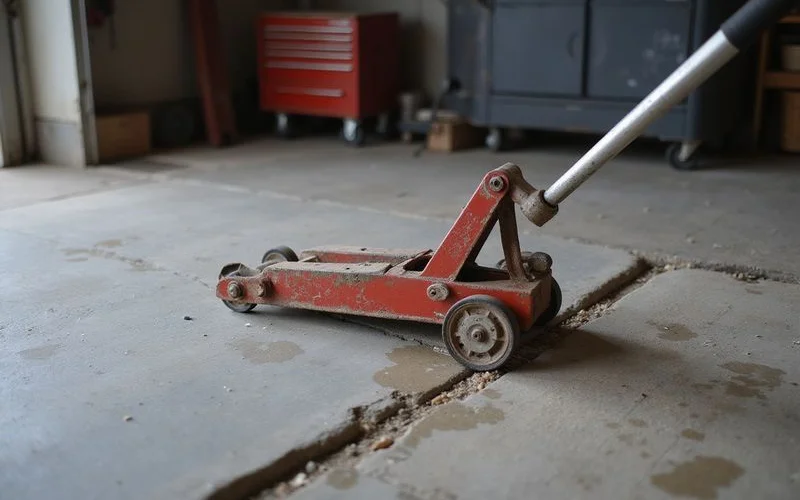
Two different movements, one visible result
Settlement is a section dropping into a void. Heave is a section being pushed up by freezing water expanding in the base. A stepped joint can be caused by either, or by both happening on opposite sides of the same line.
Why Sections Move at Different Rates
The fill isn’t uniform. Backfill depth varies across a garage footprint. Nearer the foundation wall it’s deep and disturbed; further out you may be over undisturbed ground. Deeper fill consolidates more.
Water arrives unevenly. Runoff concentrates at the door line and along the foundation. Whichever section sits closest to that water loses base material fastest. This is why the step usually shows up in a predictable place rather than in the middle of the floor.
Freeze-thaw works both ways. Water trapped under one section can freeze and lift it while the section next to it, better drained, stays put or drops. Connecticut runs this cycle repeatedly through a single winter, not once. The mechanics are covered further in why garage floors sink.
Load isn’t uniform either. The section you park the heavy vehicle on takes more cyclic load than the section holding the workbench.
What a Step Costs You
| Impact | What it looks like in practice |
|---|---|
| Trip hazard | An unlit edge you cross while carrying groceries or tools |
| Equipment catching | Floor jacks, dollies, tool chests, and mowers snagging the lip |
| Water pooling | The low side collects meltwater from vehicles and holds it |
| Joint deterioration | The exposed edge spalls and chips as it gets hit repeatedly |
| It keeps getting worse | The open joint funnels more water into the base under the low side |
That last one is the reason not to wait. The step is not a stable end state. It’s an active water channel into the exact material whose loss created it.
Bringing Them Back Flush
The repair is a staged lift, and staged is the operative word. Bringing two slabs flush is a precision job in a way that raising a single sunken section is not. The target isn’t a height, it’s a match.
Ports are placed to bracket the joint so the low section can be controlled along its full length rather than lifted at one point. Polyurethane goes in, fills the void underneath, and then raises the section in short passes. Between each pass the crew checks the level across the joint. Overshoot and you’ve simply moved the step to the other side.
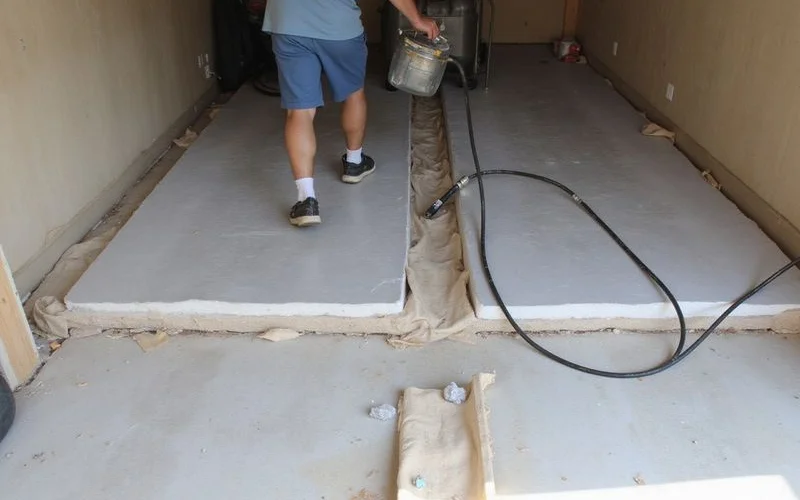
Where a section has heaved rather than settled, the reference changes: the surrounding floor becomes the target rather than the raised slab, and the neighbouring low sections come up to meet it.
Sealing the control joint after the lift is the step that makes it last. It closes the water path that let the two sections drift apart in the first place. Most stepped-section jobs are a few hours, and with a roughly 15-minute cure the garage is back in use the same day.