What’s Actually Happening Under the Slab
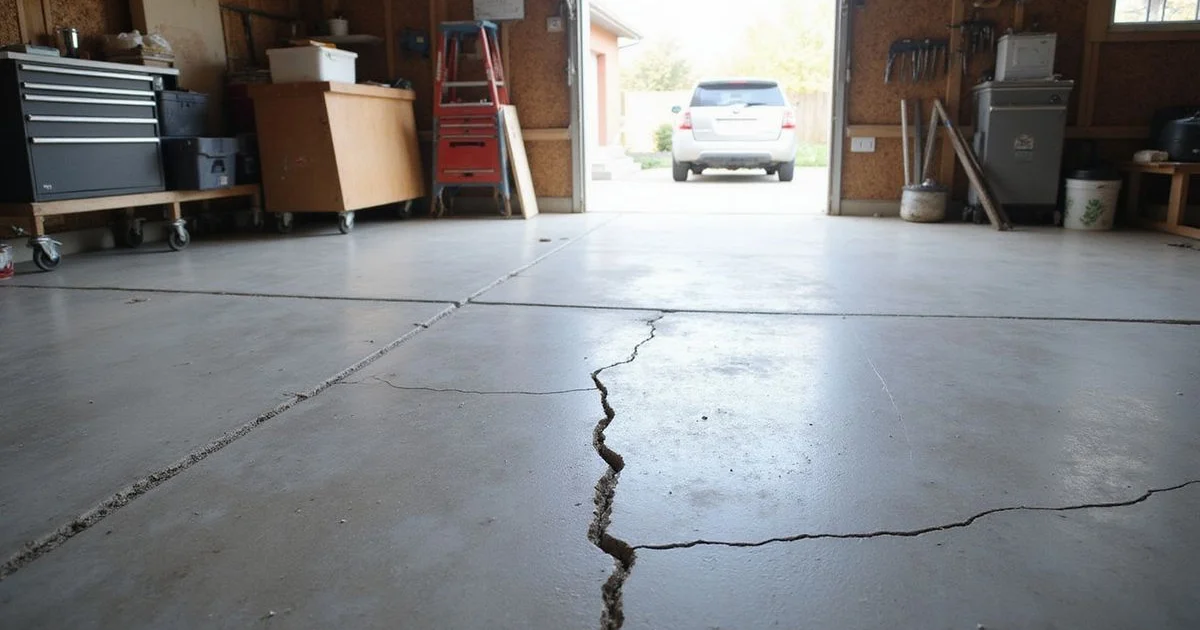
A sinking garage floor is not usually a concrete problem. The concrete is doing what concrete does. What changed is what’s underneath it.
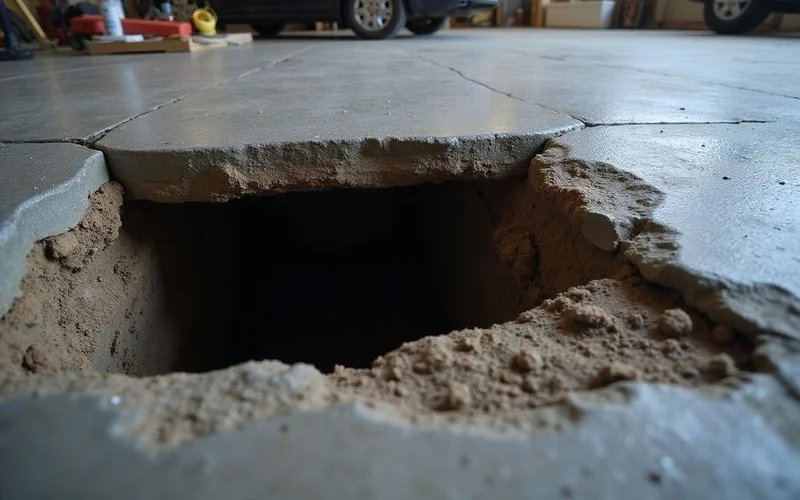
Your garage slab was poured over backfill, the material used to refill the trench around the foundation after the walls went up. Backfill is disturbed soil. No matter how carefully it was compacted at the time, it will not match the density of ground that has never been excavated, and it continues consolidating for years after the build.
As it consolidates, it pulls away from the underside of the slab and leaves a void. The concrete, now spanning empty space, drops into it. That’s the whole mechanism, and it’s why garage floor leveling targets the cavity rather than the surface.
Why the house stayed put and the garage didn’t
Foundation footings reach below Connecticut’s 42-inch frost line onto undisturbed ground. The garage slab sits inches down on backfill, inside the freeze-thaw zone. They were built to behave differently, and they do.
The Three Causes, in Order
Backfill settlement. The slowest and most common. Disturbed fill compacts under its own weight and under vehicle load. Nothing is wrong; it’s just physics working on a timescale of years.
Water intrusion. Runoff at the door line, along the foundation, and through any open joint carries fine material out of the base. This is what turns gentle consolidation into a real cavity, and it’s why settlement is almost never even across a floor. The section closest to the water source goes first.
Freeze-thaw movement. Water trapped in the base freezes and expands by about nine percent, displacing material sideways. On thaw it drains and takes fines with it. In Connecticut this runs many cycles per winter, not just one.
Reading the Cracks
Cracks tell you what moved.
A crack running across an obvious dip is settlement cracking. The slab lost support over that area, flexed under load, and failed in tension. Concrete is strong in compression and weak in tension, so an unsupported span cracks readily.
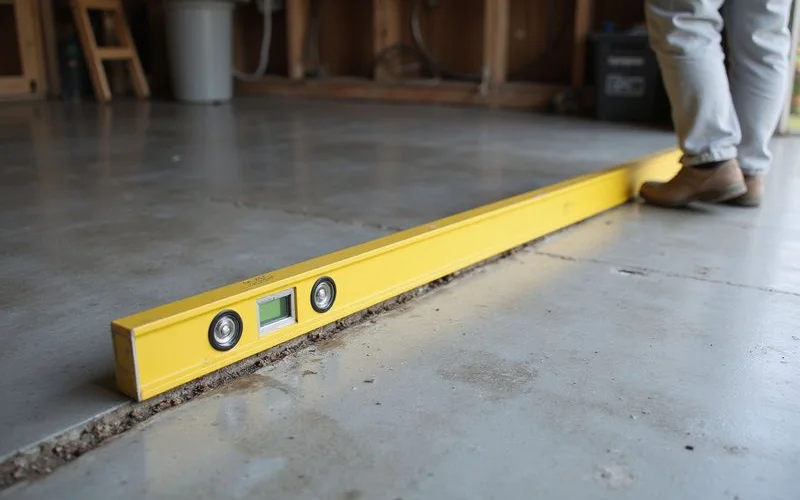
Sections that have stepped apart at a control joint mean the two are moving at different rates, usually one dropping into a void while the other stays put or heaves. That’s covered in more detail in stepped or heaved garage slab sections.
Fine surface crazing with no height change is generally shrinkage from the original cure. It’s cosmetic and unrelated to settlement.
A gap under the garage door means the slab has dropped away from the threshold line. The door hasn’t moved; the floor has.
| What you see | What it means | Can it be lifted? |
|---|---|---|
| Dip with a crack across it | Void underneath, slab flexed and failed | Yes, if the concrete is otherwise sound |
| Two sections stepped apart | Differential movement at a joint | Yes, staged lift brings them flush |
| Daylight under the garage door | Slab dropped away from the threshold | Yes, raised back to the door line |
| Concrete crumbling or spalled through | Material failure, not settlement | No, this is a repour |
How Lifting Fixes It
The repair sequence follows the diagnosis. Coin-sized ports go in over the settled area. Two-part polyurethane is injected, expands into the void, and fills it completely as structural material. Continued expansion then raises the slab in stages, with the level checked between passes so the finished floor comes back flat rather than overshooting.
Filling the void is the part that lasts. Raise the concrete without filling the cavity and you’ve bought a couple of seasons. Fill it properly and the slab has continuous support again, which is what stops the flexing that cracked it.
The foam is load-bearing. That’s not a marketing claim, it’s why the material class is specified for slab support under vehicles in the first place. Most residential garage jobs are back in service the same day.